Isoparametric Formulation
Isoparametric Formula for 2D Elements
Finite Element for Plane Problems
Element types:
- Triangular
- Constant Strain Triangle (CST, T3)
- Linear Strain Triangle (LST, T6)
- Rectangular
- Bilinear rectangle (Q4)
- Quadratic rectangle (Q8)
 In reality, both cannot meet our needs (Triangular: low accuracy; Rectangular: simple geometry only). So we need to use isoparametric elements:
- high accuracy
- arbitrary geometry
- simple computer programming
We will first consider 4 node isoparametric 2D plane elements.
Isoparametric Formula
\[ \mathbf{k}^e = \int_V \mathbf{B}^T \mathbf{D} \mathbf{B} \, \mathrm{d} V \]
用全局坐标求解 \(\mathbf{k}^e\) 的话,\(\mathbf{B}\) 不是常数,积分非常麻烦!
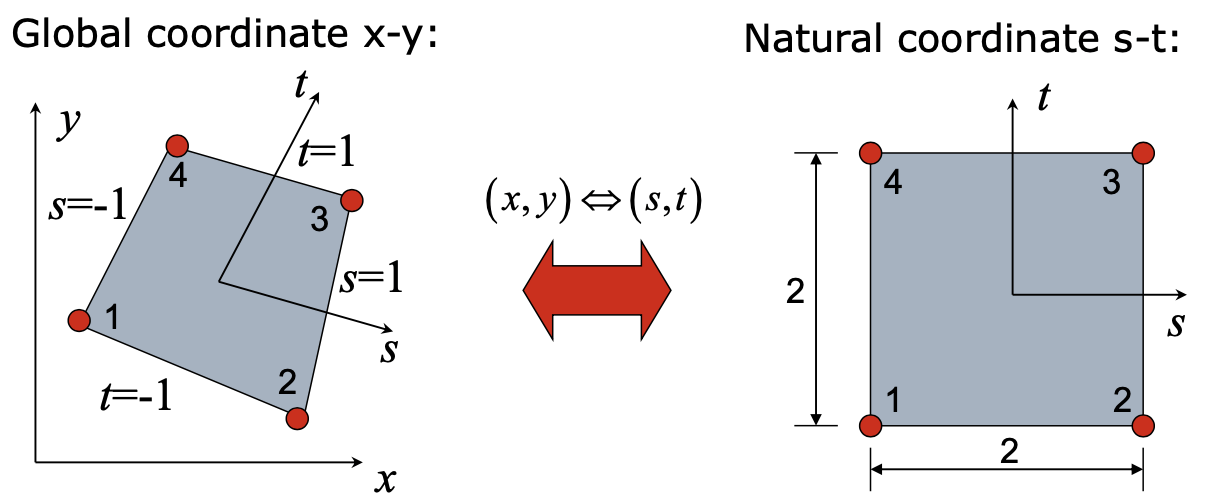
全局坐标系 \((x, y)\) 与自然(局部)坐标系 \((s, t)\) 之间存在一一映射关系。设映射为
\[ \begin{aligned} x &= a_1 + a_2 s + a_3 t + a_4 s t \\ y &= b_1 + b_2 s + b_3 t + b_4 s t \end{aligned} \]
代入四个节点的坐标,当然可以得到各个系数。不过更简单的做法是从形函数出发。因为形函数仅在节点处取值为 \(1\),所以可以直接构造
\[ \begin{aligned} N_1 &= \frac{1}{4} (1 - s) (1 - t), \quad N_2 = \frac{1}{4} (1 + s) (1 - t) \\ N_3 &= \frac{1}{4} (1 + s) (1 + t), \quad N_4 = \frac{1}{4} (1 - s) (1 + t) \end{aligned} \]
Shape and Displacement Interpolation
Shape:
\[ x = \sum_{i = 1}^4 N_i(s, t) x_i, \quad y = \sum_{i = 1}^4 N_i(s, t) y_i \]
Displacement:
\[ u = \sum_{i = 1}^4 N_i(s, t) u_i, \quad v = \sum_{i = 1}^4 N_i(s, t) v_i \]
Here, the shape and displacements are interpolated by the same shape functions, which is the reason why this formulation is called "isoparametric".
Strain matrix
\[ \boldsymbol{\varepsilon} = \begin{bmatrix} \frac{\partial}{\partial x} & 0 \\ 0 & \frac{\partial}{\partial y} \\ \frac{\partial}{\partial y} & \frac{\partial}{\partial x} \end{bmatrix} \begin{bmatrix} u \\ v \end{bmatrix} = \begin{bmatrix} \frac{\partial}{\partial x} & 0 \\ 0 & \frac{\partial}{\partial y} \\ \frac{\partial}{\partial y} & \frac{\partial}{\partial x} \end{bmatrix} \mathbf{N} \mathbf{d} = \mathbf{B} \mathbf{d} \]
we need to solve the derivatives \(\frac{\partial N_i}{\partial x}\) and \(\frac{\partial N_i}{\partial y}\). By the chain rule,
\[ \begin{aligned} \frac{\partial N_i}{\partial s} &= \frac{\partial N_i}{\partial x} \frac{\partial x}{\partial s} + \frac{\partial N_i}{\partial y} \frac{\partial y}{\partial s} \\ \frac{\partial N_i}{\partial t} &= \frac{\partial N_i}{\partial x} \frac{\partial x}{\partial t} + \frac{\partial N_i}{\partial y} \frac{\partial y}{\partial t} \end{aligned} \]